This site is intended for US
Healthcare Professionals only

This site is intended for US Healthcare Professionals only

IT’S TIME TO CONSIDER

THE IMPACT OF THE

MENIN PATHWAY1-7

IT’S TIME TO CONSIDER THE

IMPACT OF THE

MENIN PATHWAY1-7

The menin pathway may play a critical role

The menin pathway may play a critical role in up to

in up to

50%

of
AMLs1-7

of AMLs1-7

Menin-dependent AML: a complex challenge

Among the complex circuitry of AML signaling systems, the menin pathway is thought to have a far-reaching impact on AML development and outcomes.1-7

The menin pathway is a crucial mediator in gene expression driving leukemogenesis1,2,4,8

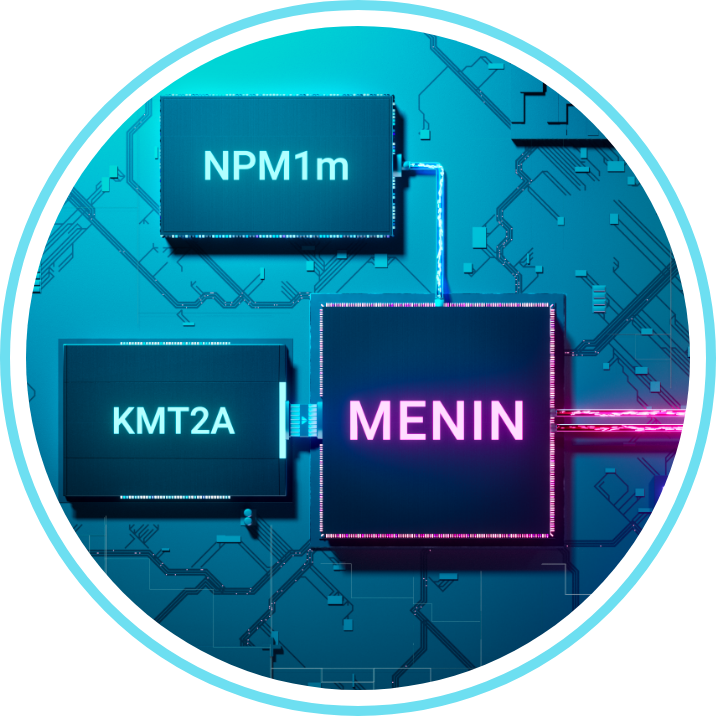
Image of a circuit board representing the Menin Pathway
The menin pathway is a complex intracellular communication system that is most commonly activated by NPM1m or KMT2Ar. It is also associated with several other genetic alterations.1-4,8-11
When menin interacts with upstream genomic alterations, such as NPM1m and KMT2Ar, it drives downstream changes in gene expression, initiating leukemogenesis.1,2,8,12,13
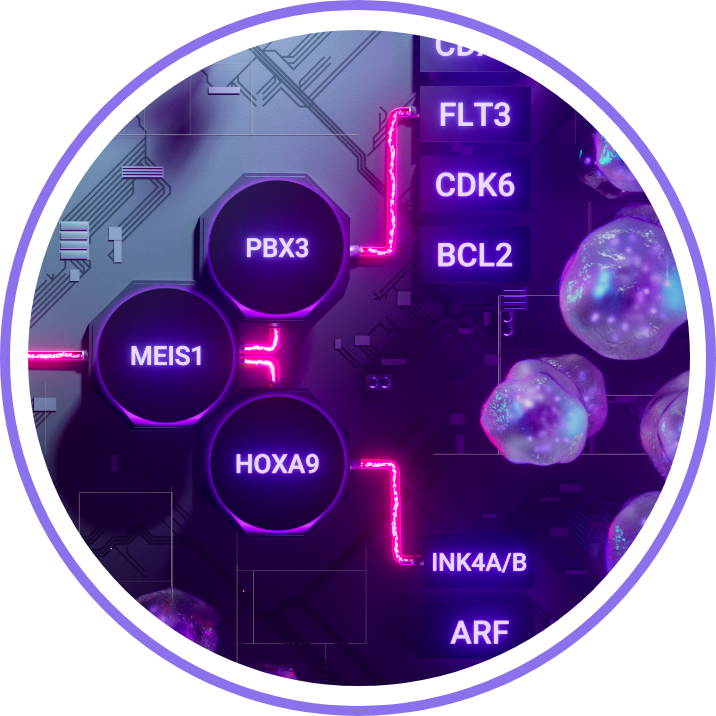
Among cases of NPM1-m AML, 39% are co-mutated with FLT3-ITD and 25% are co-mutated with IDH1/2m.14,15
image of a circuit board representing menindependent mutations

By decoding the mechanisms through which menin affects leukemic cell behavior, it is possible to enhance the understanding of menin-dependent AMLs2,4

In NPM1-m AML, mOS typically declines following relapse16

In a study of patients with R/R NPM1-m AML, mOS was 7.8 months after the first treatment,
and 5.3 and 3.5 months after the second and third treatments16
AML, acute myeloid leukemia; FLT3-ITD, FMS-like tyrosine kinase 3 receptor internal tandem duplication; IDH1/2m, isocitrate dehydrogenase 1 and 2 mutation; KMT2Ar, histone-lysine N-methyltransferase 2A rearrangement; mOS, median overall survival; NPM1-m, mutated nucleophosmin 1; NPM1m, nucleophosmin 1 mutation; R/R, relapsed or refractory.

References

1. Burrows F et al. Poster presented at: AACR-NCI-EORTC International Conference on Molecular Targets and Cancer Therapeutics: Discovery, Biology, and Clinical Applications; October 26-30, 2017; Philadelphia, PA. 2. Candoni A et al. Hematol Rep. 2024;‌16(2):244-254. 3. Falini B et al. Blood Cancer Discov. 2024;5(1):8-20. 4. Issa GC et al. Leukemia. 2021;35(9):2482-2495. 5. Bertrums EJM et al. Haematologica. 2023;108(8):2044-2058. 6. National Cancer Institute. Accessed October 22, 2024. https://seer.cancer.gov/seertools/hemelymph/51f6cf59e3e27c3994bd547d/ 7. National Cancer Institute. Accessed October 22, 2024. https://seer.cancer.gov/seertools/hemelymph/5a7e288d1ef557f9c8636d31/ 8. Falini B et al. Blood. 2020;136(15):1707-1721. 9. Collins CT et al. Curr Opin Hematol. 2016;23(4):354-361. 10. Lu R et al. Cancer Cell. 2016;30(1):92-107. 11. Wang R et al. Front Oncol. 2022;12:972606. 12. Wang GG et al. Blood. 2005;106(1):254-264. 13. Choudhury R et al. EMBO Rep. 2011;‌12(5):463-469. 14. Papaemmanuil E et al. N Engl J Med. 2016;374(23):2209-2221. 15. Sharma N et al. Cancers (Basel). 2023;‌15(4):1177. 16. Issa GC et al. Blood Adv. 2023;7(6):933-942.